
Micro Spherical Lens
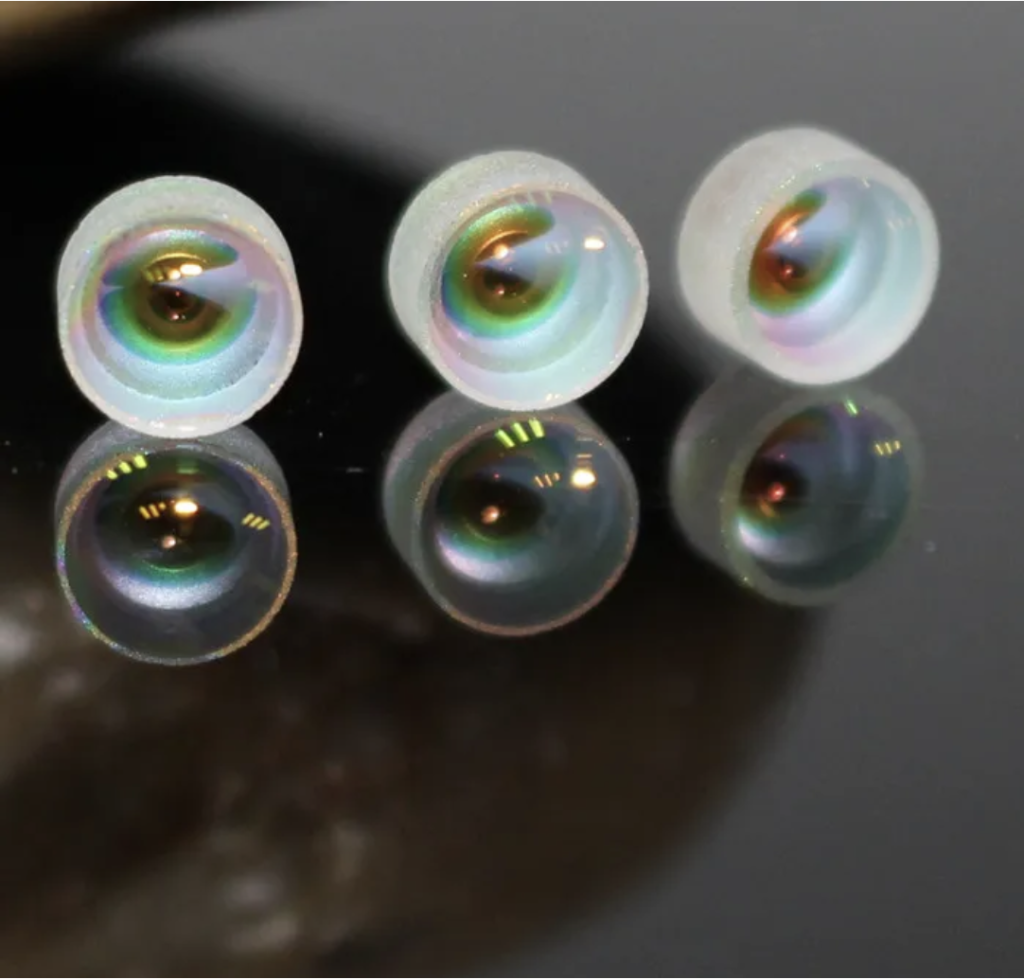
Micro Spherical Lens
Ashley-Tech manufacture Micro lens, the minimum diameter is 0.1mm from optical glass substrate and deliver high-precision optical performance for fiber coupling, LED collimation, micro-imaging and sensing applications. Diameters range from 0.1 mm to 8 mm with diameter tolerances as tight as +0/-0.02 mm and surface quality up to 10-5. Available materials include BK7, UV fused silica (UVFS), Ge, Si, CaF₂ and sapphire to meet UV–IR transmission requirements. Standard AR coatings cover 350–650 nm, 650–1050 nm and 1050–1585 nm, or can be customized to customer band requirements. We offer custom centeration (≤3 arcmin), chamfers per spec, and full QC documentation. Request a datasheet or 2D/3D CAD to evaluate integration in your assembly.
What is Micro Lens?
Micro lenses refer to small lenses with diameters ranging from tens of micrometers to several millimeters. The basic principle is to achieve the focusing or divergence of light by changing the curvature of the lens. When light passes through a microlens, the direction of light propagation can be altered according to the shape of the lens. Microlenses can be divided into two types: convex lenses and concave lenses. Among them, convex lenses can make parallel light converge at the focal point after passing through the lens. When light passes through a convex lens, the center of the lens is thicker and the edge is thinner, causing the light to refract when passing through the lens, thus focusing the light at a single point. On the contrary, concave lenses make parallel light diverge after passing through the lens. The center of a concave lens is thinner and the edge is thicker, causing the light to refract when passing through the lens, thus causing the light to diverge. Due to the extremely small size and unique optical properties of microlenses, they can be used in various fields. They can be made into different shapes and sizes, such as spherical, cylindrical, conical, etc. By combining multiple microlenses together, complex optical systems can be achieved, such as microscopes, telescopes, lasers, etc. The applications of microlenses include optical communication, medical imaging, display technology, optical detection, bioengineering, etc. It is one of the most important technologies in the field of optics at present. With the continuous development and improvement of technology, the application scope of microlens technology will become increasingly wide
| Structure | Micro lens |
| Material | Optical glass, UVFS, Germanium, Silicon, CaF2, MgF2, ZnSe ZnS, Sapphire |
| Diameters Available | 0.1mm available |
| Diameter Tolerance | +0.00/-0.02mm or customer design |
| Surface Quality | 10-5 |
| Surface Irregularity | λ/10 @632.8nm or customer design |
| Thickness tolerance | +0/-0.02mm |
| Clear Aperture | >90% of Diameter |
| Chamfer | 0.05-0.5mmx45degree, according to customer’s needs. |
| Centeration | 3 arcmin |
| Coating | Single Mag2, Multiple Layers AR Coating A: 350-650nm B: 650-1050nm C: 1050-1585nm D: Customer Design |
Applications
Micro ball lenses are widely used in:
Fiber optic coupling and collimation
Laser beam focusing systems
LED collimation and light shaping
Optical sensors and detectors
Medical and endoscopic imaging systems
Barcode scanners and micro-optics assemblies
Advantages
Compared with traditional lenses, spherical ball micro lenses offer:
Compact size for space-limited designs
Symmetrical geometry for uniform optical performance
Easier alignment in fiber coupling applications
Cost-effective solution for mass production
High durability and long service life