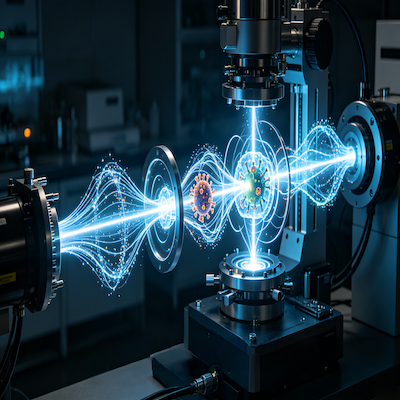
Engineers at Brookhaven National Laboratory (BNL) in the United States have designed a strange new X-ray microscope, which uses the strange world of quantum physics to perform high-resolution “ghost imaging” of biomolecules, but the radiation dose is low. X-ray microscope is a useful tool for high-resolution imaging of samples, but the radiation involved will damage sensitive samples, such as viruses, bacteria and some cells. Reducing the radiation dose is one way to solve this problem, but unfortunately, it also reduces the resolution of the image. Now, the research team at Brookhaven National Laboratory has found a way to maintain a high resolution with a low radiation dose-all they have to do is take advantage of the strangeness of quantum physics, which makes Einstein and others puzzled. In a standard X-ray microscope, a beam of photons is sent through the sample and collected by a detector on the other side. But in the team’s new quantum enhanced X-ray microscope, the beam is divided into two beams, only half of which pass through the sample-however, both beams can be measured. How is that possible? This is all due to a strange phenomenon called quantum entanglement. In essence, two particles can become so entangled that the interaction with one of them will immediately change the state of their partners, no matter how far apart they are. This means that information moves between them faster than the speed of light, which is considered as a hard limit-so Einstein is unwilling to accept this phenomenon. In the case of a new X-ray microscope, the beam splitter produces pairs of entangled photons. One of them passes through the sample and transmits information to the detector as usual. But at the same time, it will also cause its partner to automatically change its state, even though it has not yet touched the sample. When it hits its own detector, it can get extra information from it. “One beam of photons passes through the sample and is collected by a detector, which records photons with good time resolution, while the other beam encodes the exact direction of photon propagation,” said Andrei Fluerasu, the chief beam line scientist of the project. “It sounds like magic. But through mathematical calculation, we will be able to correlate the information of the two beams. ” This process is called “ghost imaging”, so far, it is only used for photons of visible light. The new microscope will be the first technology to adapt this technology to X-rays, allowing images of samples smaller than 10 nanometers to be captured without destroying them. With the design and concept planning, the new X-ray microscope will be built in the National Synchrotron Radiation Source II(NSLS-II). If everything goes according to plan, it should start running in 2023.