
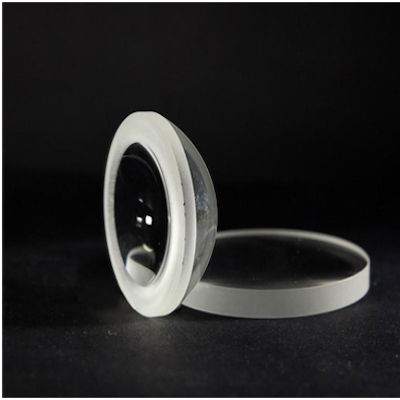
The difference between the two surfaces of the curved moon lens as the incident surface, compared with the flat-convex lens, the curved moon lens has a special feature – it also has a positive and negative light focus surface, which will cause the impact of the incidence direction to be more significant than the flat-convex lens.
Positive curved moon lens: the center is thick and the edge is thin, and the whole plays a converging role (such as f>0)
Negative curved moon lens: the center is thin and the edge is thick, and the whole plays a divergent role (such as f<0)
It is different from the flat convex lens, mainly reflected in two points:
First, it is necessary to distinguish between positive and negative curved moon types, which is much more complicated than flat-convex lenses;
The second is the asymmetry caused by the difference in the radius of curvature of the convex and concave surfaces;
1. Spherical aberration
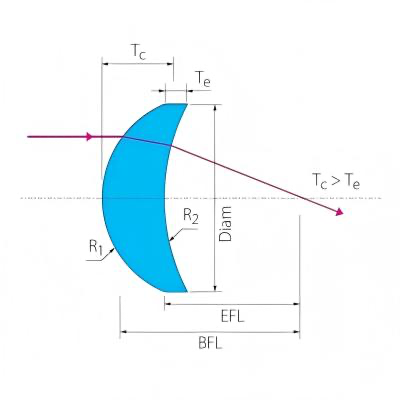
Positive curved moon lens (concentrating type)
Convex incident:
The light gathers through the convex surface first, and then diverges slightly through the concave surface.
Reduction of ball difference: The divergence effect of the concave surface offsets the excessive deflection of the light at the edge of the convex surface.
Concave incident:
The light diverges first through the concave surface, and then gathers through the convex surface.
Increased ball difference: the initial divergence leads to an increase in the demand for subsequent gathering, and the edge light is too biased.
Home pageꄲNews ꄲ Popularization of optical knowledge ꄲ Analysis of the difference between different surfaces of curved moon lens for light incidence
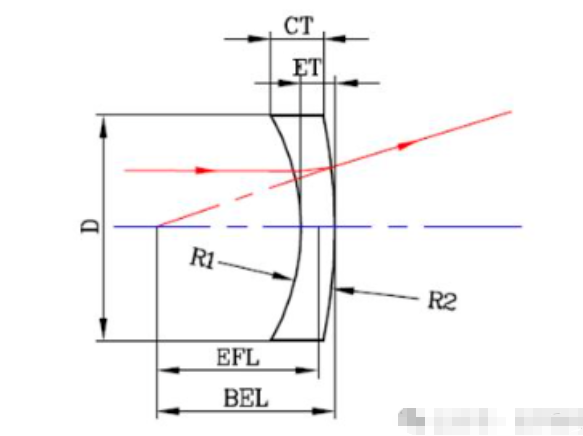
The difference between the two surfaces of the curved moon lens as the incident surface, compared with the flat-convex lens, the curved moon lens has a special feature – it also has a positive and negative light focus surface, which will cause the impact of the incidence direction to be more significant than the flat-convex lens.
Positive curved moon lens: the center is thick and the edge is thin, and the whole plays a converging role (such as f>0)
Negative curved moon lens: the center is thin and the edge is thick, and the whole plays a divergent role (such as f<0)
It is different from the flat convex lens, mainly reflected in two points:
First, it is necessary to distinguish between positive and negative curved moon types, which is much more complicated than flat-convex lenses;
The second is the asymmetry caused by the difference in the radius of curvature of the convex and concave surfaces;
1. Spherical aberration

Positive curved moon lens (concentrating type)
Convex incident:
The light gathers through the convex surface first, and then diverges slightly through the concave surface.
Reduction of ball difference: The divergence effect of the concave surface offsets the excessive deflection of the light at the edge of the convex surface.
Concave incident:
The light diverges first through the concave surface, and then gathers through the convex surface.
Increased ball difference: the initial divergence leads to an increase in the demand for subsequent gathering, and the edge light is too biased.

Positive curved moon lens (concentrating type)
Convex incident:
The light gathers through the convex surface first, and then diverges slightly through the concave surface.
Reduction of ball difference: The divergence effect of the concave surface offsets the excessive deflection of the light at the edge of the convex surface.
Concave incident:
The light diverges first through the concave surface, and then gathers through the convex surface.
Increased ball difference: the initial divergence leads to an increase in the demand for subsequent gathering, and the edge light is too biased.
Positive curved moon lens (concentrating type)
Convex incident:
The light gathers through the convex surface first, and then diverges slightly through the concave surface.
Reduction of ball difference: The divergence effect of the concave surface offsets the excessive deflection of the light at the edge of the convex surface.
Concave incident:
The light diverges first through the concave surface, and then gathers through the convex surface.
Increased ball difference: the initial divergence leads to an increase in the demand for subsequent gathering, and the edge light is too biased.
| Characteristics | The convex surface is used as the incident surface. | The concave surface is used as the incident surface. |
| The difference between the spheres | Positive bend moon: reduceNegative curved moon: increase | Positive curved moon: increaseNegative bend moon: reduce |
| Field curve correction ability | Bend Moon: Compensation like square field songNegative Curved Moon: Compensation Square Field Curve | Reverse action, destroying the balance of field curve |
| Like scattering control | It’s better (especially the right moon) | Poor |
| The best applicable scenario | Zhengben Moon: The Last piece of the Imaging SystemNegative Curved Moon: The first film of wide-angle lens | Special needs (such as reverse optical path) |
Positive curved moon lens (concentrating type)
Convex incident:
The light gathers through the convex surface first, and then diverges slightly through the concave surface.
Reduction of ball difference: The divergence effect of the concave surface offsets the excessive deflection of the light at the edge of the convex surface.
Concave incident:
The light diverges first through the concave surface, and then gathers through the convex surface.
Increased ball difference: the initial divergence leads to an increase in the demand for subsequent gathering, and the edge light is too biased.