
xxxxxx
xxxxx
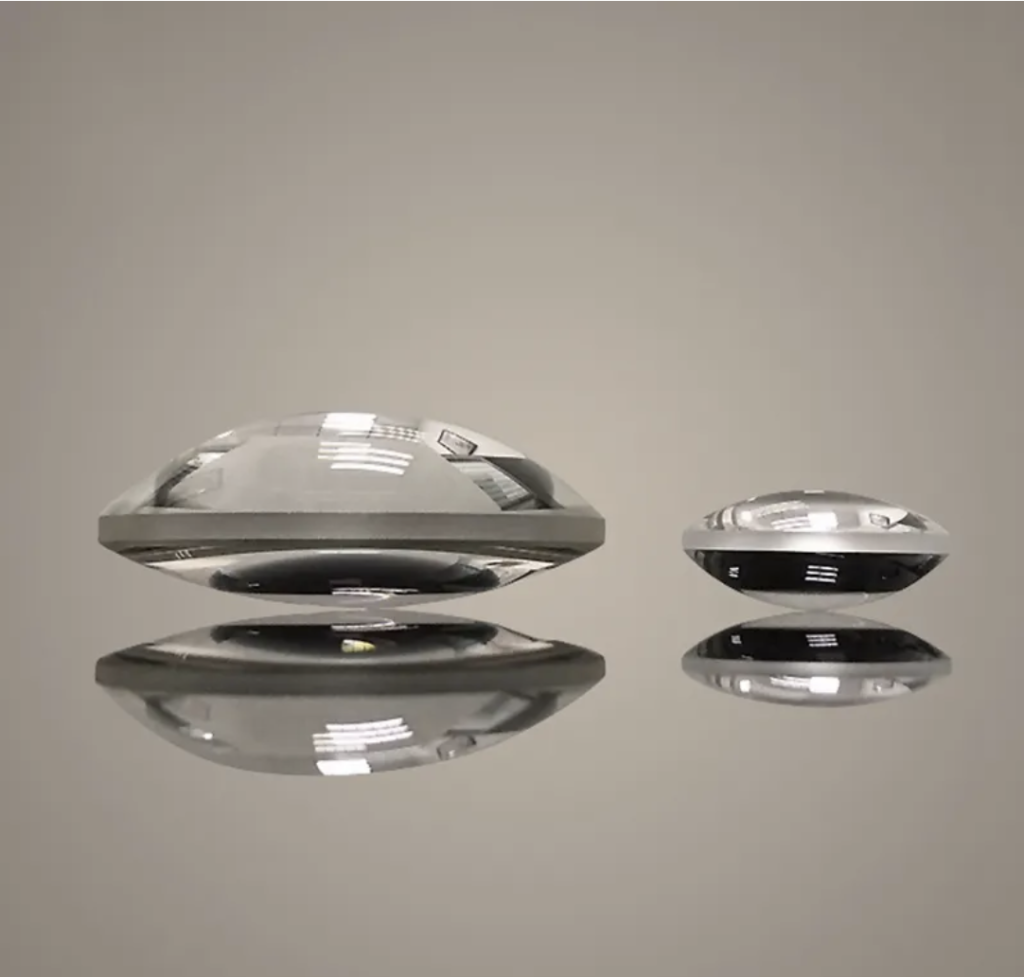
A bi‑convex lens, also known as a double convex lens, is an optical lens with two outwardly curved spherical surfaces. Double convex lens has two convex focal length which used for various applications such as magnifying, optics and laser systems. This symmetrical design allows parallel light rays to converge at a single focal point, producing a positive focal length. Bi‑convex lenses are widely used in optical systems for focusing, imaging, and beam steering.
Sunday Optics can manufacture double convex lenses with two equal radius or two different convex radius
These lenses are essential components in laser systems, microscopes, telescopes, imaging devices, and optical measurement instruments. Their ability to converge light with minimal aberration makes them ideal for both laboratory and industrial applications.
Parameter
| Structure | Bi Convex Lens |
| Material | Optical glass, UVFS, Germanium, Silicon, CaF2, MgF2, ZnSe ZnS, Sapphire |
| Diameters Available | 0.3mm to 600mm |
| Diameter Tolerance | +0.00/-0.01mm or customer design |
| Surface Quality | 10-5 |
| Surface Irregularity | λ/10 PV @632.8nm or customer design |
| Thickness tolerance | +0/-0.01mm |
| Clear Aperture | >90% of Diameter |
| Chamfer | 0.05-0.5mmx45degree, according to customer’s needs. |
| Centeration | <10 arcsec |
| Coating | Single Mag2, Multiple Layers AR Coating A:350-650nm B:650-1050nm C:1050-1585nm D: Customer Design |
Bk7 Standard Double Convex Lens
| No. | EFL(mm) | Dia.(mm) | R1=R2(mm) | Material | Tc(mm) | Te(mm) |
| SD2A125 | 20 | 12.70 | 20.01 | Bk7 | 4.00 | 2.00 |
| SD2A125 | 50 | 12.70 | 51.35 | Bk7 | 2.79 | 2.00 |
| SD2A127 | 75 | 12.70 | 77.30 | BK7 | 2.60 | 2.00 |
| SD2A120 | 100 | 12.70 | 103.25 | BK7 | 2.40 | 2.00 |
| SD2A252 | 25.40 | 25.40 | 24.712 | BK7 | 9.00 | 2.00 |
| SD2A255 | 50.00 | 25.40 | 50.92 | BK7 | 5.20 | 2.00 |
| SD2A257 | 75.00 | 25.40 | 77.09 | BK7 | 4.11 | 2.00 |
| SD2A250 | 100 | 25.40 | 103.04 | BK7 | 3.57 | 2.00 |
| SD2A252 | 200 | 25.40 | 207.00 | BK7 | 2.78 | 2.00 |
| SD2A25B | 250 | 25.40 | 258.90 | BK7 | 2.62 | 2.00 |
| SD2A25C | 500 | 25.40 | 508.30 | BK7 | 2.31 | 2.00 |
Key Specifications
Understanding the parameters of a bi‑convex lens is crucial for selecting the right component for your optical system:
Focal Length (EFL): Determines the focusing capability; available in short, medium, or long focal lengths.
Clear Aperture (CA): The usable optical area, typically expressed as a percentage of the lens diameter.
Surface Quality: Measured in scratch-dig standards (e.g., 40-20), affecting imaging clarity.
Surface Irregularity: Determines wavefront distortion, typically specified in fractions of a wavelength (λ).
Coating Options: Anti-reflective (AR) coatings for different wavelength ranges (UV, VIS, NIR) to improve transmission.
Material Choices: BK7, UV Fused Silica, CaF₂, ZnSe, Germanium, Silicon—covering visible, UV, and IR applications.
| Material | Wavelength Range | Recommended Use |
|---|---|---|
| BK7 | 400–2000 nm | General imaging, laser & optical systems |
| UV Fused Silica | 190–3500 nm | UV laser & high-transmission optics |
| CaF₂ | 130–9500 nm | UV & IR applications |
| ZnSe | 1–14 µm | Mid-IR laser optics |
| Germanium / Silicon | IR bands | Thermal imaging, IR systems |
Applications
Double convex lenses are applied in multiple industries and scientific fields:
Laser & Photonics: Beam focusing, collimation, and laser measurement systems
Imaging & Microscopy: Magnification, lens assemblies, and optical instruments
Telescopes & Astronomy: Objective lenses for visible light observation
Optical Measurement: Interferometry, spectroscopy, and alignment systems
Industrial & Scientific Research: UV, VIS, and IR optics for experiments and devices
This diversity makes bi-convex lenses an essential part of many B2B procurement projects in precision optics.