
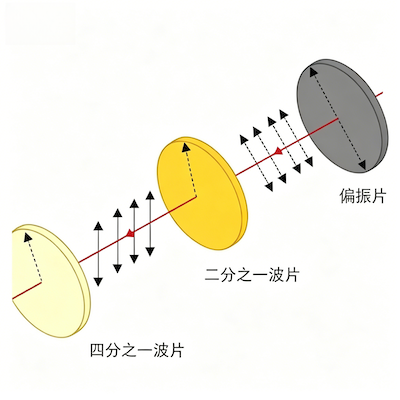
In many optical system designs, waveplate is a common but often misunderstood device. Many people know that it “can change polarization”, but it is not clear how it changes, why it is used, and what role it really plays in engineering systems. Today, we will explain the difference between λ/2 (half-wave sheet) and λ/4 (quarter wave sheet) from the engineering perspective, so that you can use them more confidently in practice.
What is a wave piece?
Wave sheet is an optical device made of birefringent materials. The so-called birefringence means that the material has different refractive indexes for the polarization components of two orthogonal directions. When light passes through the wave sheet in these two directions, a phase difference occurs between the two orthogonal components of the light due to different phase speeds.
This phase difference is the basis of the principle of the wave sheet to change the polarization state:
Polarized light can be regarded as the superposition of two orthogonal components. By changing the phase between them, we can control the nature and direction of polarization.
λ/2 (half-wave sheet): the “rotator” of the polarization direction
The λ/2 wave sheet can produce a phase difference of 180° (π) between two orthogonal components.
This phase difference will not change the “type” of polarization light, but it will change the direction of polarization.
An important rule in the project is:
When the linearly polariced light is incident to the λ/2 wave plate, and there is an angle θ between the fast axis of the wave plate and the original polarization direction, the direction of the output polarization will rotate 2θ.
That is to say:
Just rotate the λ/2 wave sheet to accurately adjust the polarization direction without changing the light path or introducing additional losses.
Engineering significance:
- Do direction matching in front of polarization-sensitive devices
- Quickly adjust the polarization direction in system debugging
- As a core component in variable ratio polarizers and polarizers
This rotation does not depend on the change of light intensity, but only on the change of phase relationship. It is the most commonly used function of λ/2 wave sheet in engineering systems.
λ/4 (quarter wave sheet): the bridge between linear polarization and circular polarization
In contrast, the λ/4 wave sheet can produce a phase difference of 90° (π/2) between two orthogonal components. This difference has a more fundamental impact on the polarization type.
If the linearly polarized light is incident on the λ/4 wave sheet at an angle of about 45°, the two orthogonal components of the output light are equal in magnitude and 90° apart, which forms circular polarization light. Similarly, when circularly polarited light passes through the λ/4 wave sheet, it will also change back to linearly polariced light.
Engineering significance:
- Generate circular polarization light in a system that requires circular polarization input
- Switch backline polarization from circular polarization state is used for analysis or detection.
- Stabilize the polarization state in polarization-sensitive devices such as optical isolators and interferometers
This type of conversion has a practical effect on reducing reflection interference and improving system stability.
The core comparison of the two wave pieces (remember in one sentence)
| Wave sheet type | Main function | Output polarization characteristics |
|---|---|---|
| λ/2 wave sheet | Rotate the direction of linear polarization | The output is still linearly polarised. |
| λ/4 wave sheet | Realize polarization type conversion | Line polarization ↔ circular polarization |
Why are these differences so important in engineering?
In engineering systems, “polorization” is not an abstract concept, but a core factor that directly affects performance:
- The laser output is often linearly polariced.
- Polarization splitters, polarization sheets and polarization-sensitive components have strict requirements for polarization direction.
- Inappropriate polarization state will lead to signal loss, interference contrast reduction and even system failure.
Therefore:
🔹 λ/2 wave sheet is used to accurately adjust the direction
🔹 λ/4 wave sheet is used for type conversion
These two devices solve different polarization needs respectively, and are often used together in engineering to obtain the established polarization effect.
Examples of practical applications in engineering
✅ Polarization matching
In the laser coupling system, it is often necessary to alim the output polarization direction of the light source with the polarization coordinates of the rear-end device (such as beam splitter). This adjustment can be completed without moving the optical path by directly rotating the λ/2 wave sheet.
✅ Circular polarization generation
In some optical isolators or polarization-sensitive detection modules, the use of circular polarization light can reduce the error caused by reflection. It is very convenient to convert linear polarization into circular polarization with λ/4 wave sheet.
✅ Complex polarization control
In high-precision interference measurement or polarization modulation system, the combination of λ/2 and λ/4 wave sheets can generate various elliptical polarization states to meet the needs of complex experiments and engineering.
Engineering elements to pay attention to when selecting wave sheets
When you buy or design wave sheets, you need to pay attention to several key points:
🔹 Working wavelength matching
The design of the wave sheet is closely related to the specific wavelength, and the wavelength deviation will cause a phase delay error.
🔹 Temperature and environmental stability
Different designs (such as zero level, color difference) have different sensitivity to temperature changes. The color-cannification wave sheet can maintain a stable delay in a wider wavelength range, which is suitable for broadband systems.
🔹 Dependence on angle of incidence
The performance of the wave sheet is sensitive to the angle of incidence, and it is necessary to pay attention to the polarization error when the beam converges or diverges.
These engineering details often directly affect the stability and performance of the system.