
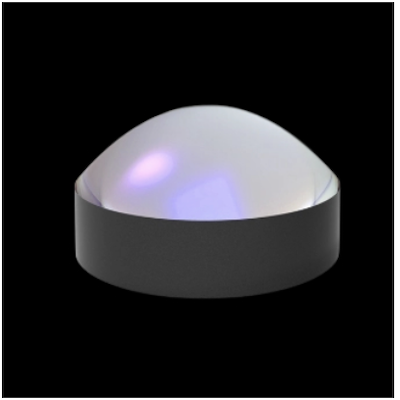
There are three categories of aspherical surfaces used in optical systems: the first category is axially symmetrical aspherical surfaces, such as rotational conical surfaces and rotational high-order surfaces; the second category is aspherical surfaces with two symmetrical surfaces, such as cylindrical surfaces and complex surfaces; the third category is free surfaces without symmetry.
However, we are specifically talking about surfaces that conform to the rotational symmetry of a specific expression, that is, the first category. The aspherical surfaces of most applications are also in this category.
I. Mathematical expression
The most commonly used aspherical expression is composed of a conical surface as a reference surface and a series of high-order polynomials. The expression is:
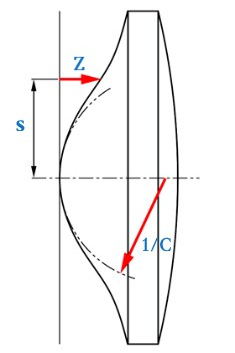

Among them:
Z = Surface contour parallel to the optical axis
s = radial distance to the optical axis
C = curvature, the inverse of the radius
k = cone constant
A4, A6, A8… It is the 4th, 6th and 8th… aspherical coefficient
The following figure shows that the actual surface of the cone will depend on the size of the value of the cone constant and the positive and negative symbols.
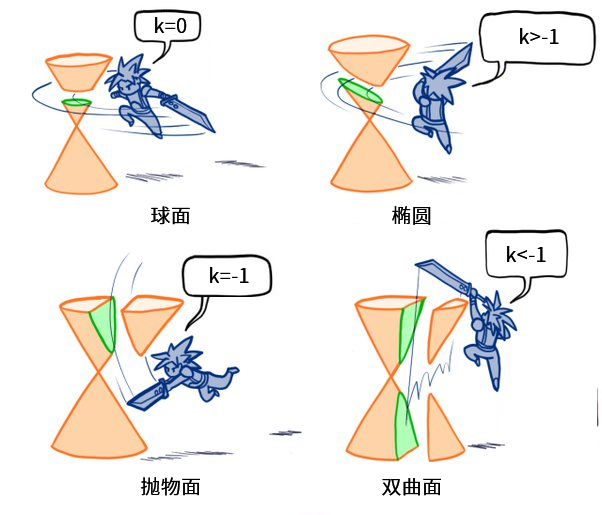
Correspondence between the cone constant k and the cone section
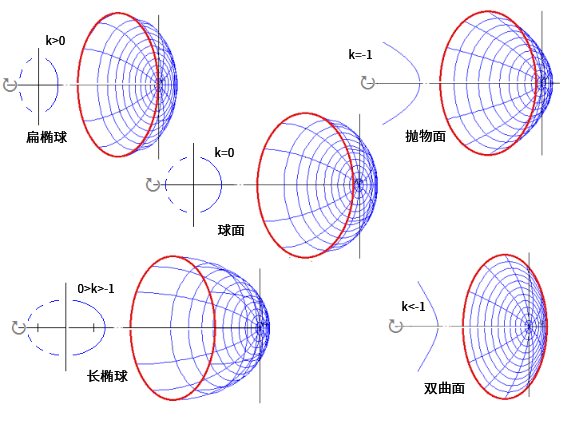
If the conical curve cross-section and the surface of the aspherical lens cannot be connected, the following figure restores the cross-section diagram to the surface diagram of the body:
II. Material selection
The more important physical parameters of optical materials are refractive index, Abe number and local dispersion value. Among them, the Abe number represents the dispersion characteristics, and the small Abe number represents the materials with high dispersion characteristics. In addition, it is also necessary to consider the transmittance values of materials in different bands, such as ultraviolet (often used in microphotogratography machines), visible light (consumer optical products), infrared light (night vision system); mechanical properties of materials, such as hardness (helping to evaluate the cost of cutting and grinding), Young’s modulus; and characteristics that change with temperature. Wait. Commonly used materials include glass, quartz crystals, polycrystalline ceramics and polymers.
1 glass
Glass with temperature phase change is suitable for aspherical lenses obtained by molding, which are mainly used as digital cameras and mobile phone cameras; glass with high transmittance in the infrared band, such as sulfide, is mostly used in military security systems.
2 Polymer
Polymers can be divided into thermoplastic polymers and thermosetting polymers. Plastic aspherical lenses can be processed by injection molding or diamond turning. Due to the dependence of the optical properties of polymers on temperature, polymers do not have long-term stability and are greatly affected by temperature and humidity.
3 microcrystalline ceramics
Microcrystalline glass with zero expansion coefficient (when the temperature changes, the size of the material changes slightly, which can maintain the stability of its shape and size) is light in weight and can be made very large in size. It is often used in astronomical observation and LCD projection systems.
4 Monocrystalline and polycrystalline ceramics
Crystal materials are expensive, and the processing of aspherical lenses of crystal materials must be carried out by computer numerical control or diamond single-point turning. The high cost of materials and processing makes such aspherical lenses can only be used in industrial and military instruments.
III. Processing technology
Economical manufacturing technology is one of the key factors for the wide application of aspherical surfaces. According to the requirements of the quantity produced by aspherical surface, the size of the aspherical surface and the tolerance value (the tolerance is formulated for the maximum allowable deviation between the actual processing surface shape and the design or theoretical surface shape), the aspherical surface can be processed by different methods, such as injection molding, glass molding or precision grinding.
Modern processing technology can be roughly divided into classical processing technology, grinding and mixing technology. For specific common technologies, please refer to the figure below. The processing steps of classical processing technology are mainly molding–polishing–local correction polishing.
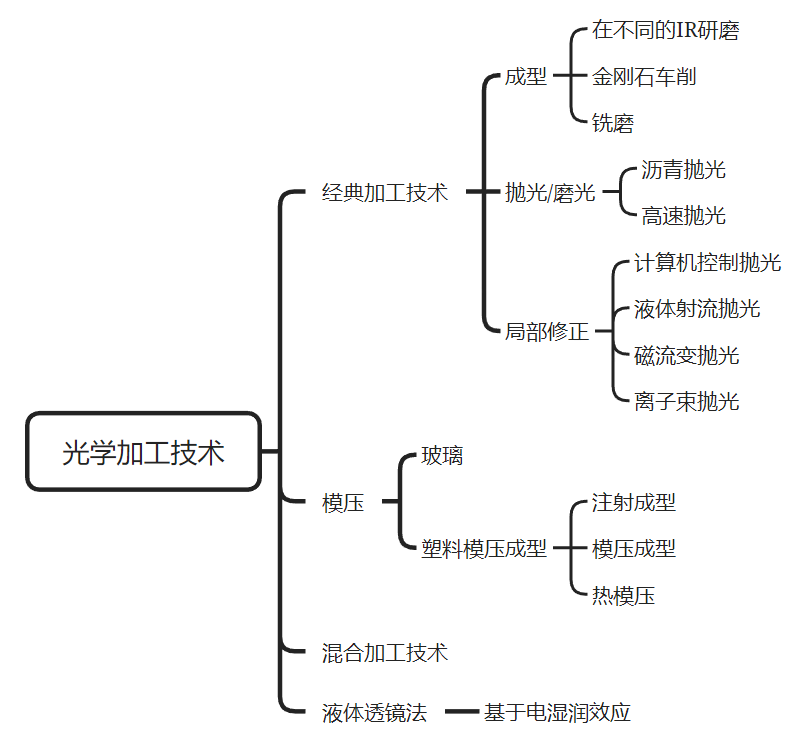
The specific composition of different processing technologies
1CNC machining
The biggest advantage of CNC (CNC machining) is the super geometry and material adaptability. It does not require special molding tools and almost all brittle materials can be processed, and the surface shape accuracy is high. The typical process of CNC machining aspherical surfaces includes three steps: ring strip grinding–ring strip polishing–magneto-rheological polishing
- Ring strip grinding: the removal of main materials and the formation of precision submicron-level aspherical surfaces;
- Strip polishing: mainly to improve surface roughness and subsurface damage, as well as intermediate frequency surface errors after grinding;
- Magneto-rheological polishing (MRF): Deterministic correction of the deformed surface to meet the formulated accuracy requirements, MRF completes the ultra-precision polishing of the polished surface. Magneto-rheological polishing is mainly between tools and workpieces through a magneto-rheological fluid technology affected by the external magnetic field, which can make nano-precision ultra-fine machining possible. Because there is no need for a special tool head, the installation time is short and flexible, which is suitable for bulk small-size production.
2 Computer-controlled polishing
CCP (computer-controlled polishing) or CCOS (computer-controlled optical surface forming method) is a modified polishing program. The purpose is to correct and polish the surface of the optical component to improve the performance of the optical component. CCP is the most widely used technology in optical enterprises. The small grinding head polishing process can be applied to almost all diameters, from a few mm-8m.
3 Ion beam polishing
Ion beam polishing (IBF) is a special computer-controlled polishing technology. The number of energy particles replaces polishing pads, liquid jets or magneto-rheological fluids in CCP as polishing tools. Accelerated ions (such as argon ions) bombard the surface of the sample on an atomic scale like sandblasting. Advantages: non-contact, no tool wear, highly predictable, removeable at the molecular level.
Ion beam technology is one of the biggest breakthroughs in optical manufacturing, which can obtain a very accurate surface. However, it is limited to high investment, high vacuum technology, low removal rate, and there are restrictions on processing materials.
4 Precision glass molding
Because grinding and polishing cannot manufacture optical elements with diffraction characteristics, and the cost of manufacturing aspherical lenses with this technology is very high. Precision glass molding technology (PGM) is a low-cost technology suitable for large-scale production suitable for the processing of glass optical components. It is a thermoforming technology that does not require cold processing of the surface.
PGM technology has been widely used in the manufacture of optical components, such as mass-produced optical imaging aspherical surfaces (diameter from 0.2 to 20mm) and lighting components (concentrators, relay lenses and integrated panels, etc., more than 200 million pieces per year), mobile phone digital cameras, communication, optical storage and optical sensing, etc., among which the typical The monthly demand for products such as mobile phones and cameras is more than 500,000 pieces.
5 High-precision polymer injection molding
Precision injection molding is for the effective manufacture of spherical, aspherical and other plastic lenses and single lenses in large quantities. Such as optical sensors for car wipers, aspherical lenses for monetary control systems and focus screens for cameras. Compared with glass, optical plastics are lighter, low in cost, more suitable for mass production, and have a high degree of freedom in optical design. This processing is more suitable for the large-scale low-cost production of aspherical optical components.
6 Aspherical microlens processing technology based on wafer technology
Aspherical microlens and microlens arrays are key components of medical applications, remote work, metrology, laser and lighting systems. Different technologies from ion diffusion, injection molding, molding and grinding to crystal-based production can be used in micro-lens production, and has been well developed. For high-quality micro-optical products, wafer-based micro-lens manufacturing technology is the most promising. It can take advantage of the ready-made processes of the semiconductor industry, such as sol, lithography, reaction ion corrosion, etc. This technology can produce microlenses from 10 microns to 2 mm, and has excellent consistency and sub-micron transverse position accuracy when producing the contours of aspherical lenses.
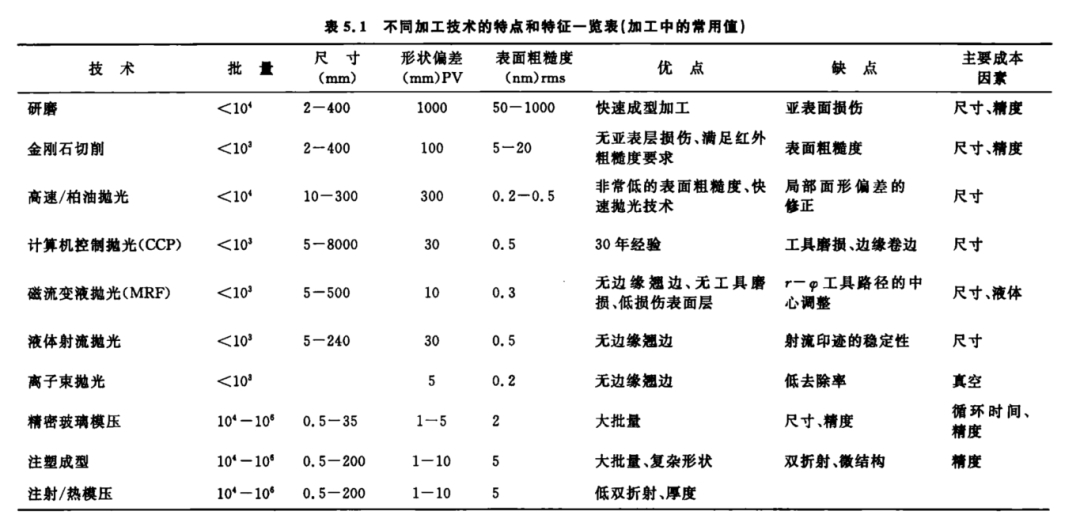
Please refer to the following table for the specific characteristics of different processing technologies:
IV. Application field and production level
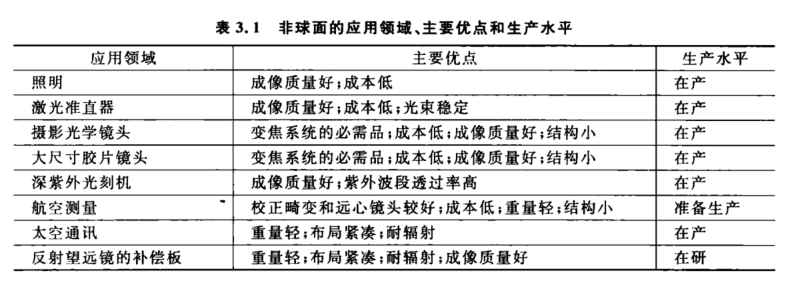
The application of aspherical surfaces is becoming more and more extensive. From a large number of consumer optical products to special objective lenses of lyphonography machines, space communication and aviation remote sensing instruments, different types of aspherical lenses are used. In the following table, we summarize the application fields, main advantages and production levels.
Of course, after understanding the design, material selection and processing technology, there is still a long way to go from the finished product of aspherical lens components. There are also optical property detection, coating, assembly and other steps. More importantly, it requires a lot of theoretical knowledge, practical experience and mass production experience.